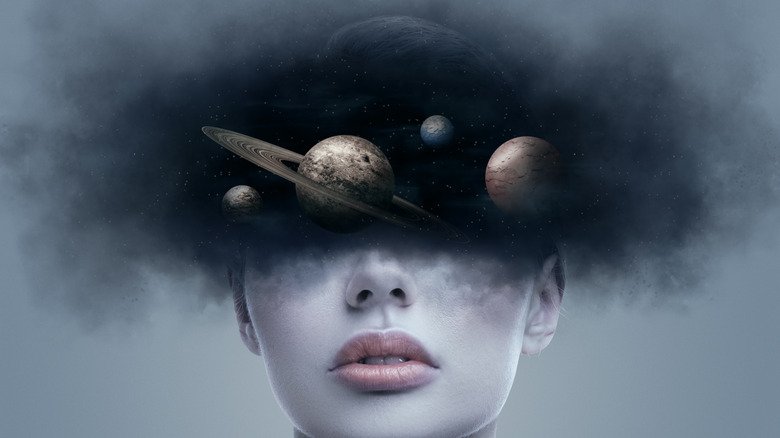
Ever wake up with a shiver, convinced that the bizarre movie playing in your head all night was more than just random brain noise? The question of "why do my dreams predict the future" has haunted humanity for centuries, blurring the lines between science, psychology, and the downright spooky. Are these glimpses into tomorrow, or just tricks of the mind? Let's dive into the fascinating world of dreams and explore whether they truly possess a prophetic power.
At a glance:
- Many believe their dreams predict the future, a phenomenon called precognitive dreaming.
- Science offers explanations like subconscious processing, pattern recognition, and coincidence.
- Psychological factors, such as belief in the paranormal, can influence dream interpretation.
- Remembering and interpreting dreams is highly subjective and prone to memory distortion.
- While concrete scientific proof is lacking, the experience of precognitive dreams persists.
The Allure of Precognitive Dreams: A Historical Perspective
From ancient civilizations to modern-day anecdotes, the belief that dreams can foresee the future has been a recurring theme. Think about it: cultures worldwide have consulted dream interpreters, viewing dreams as messages from the gods or glimpses into the spirit world. Even prominent figures like Abraham Lincoln reportedly had dreams hinting at future events. These stories, however anecdotal, fuel the enduring fascination with dream prophecy.
Defining Precognitive Dreams: What Exactly Are We Talking About?
Before we delve deeper, let's clarify what we mean by "precognitive dreams." These aren't just any dreams; they're dreams that seem to accurately predict future events. For a dream to be considered precognitive, several criteria usually apply:
- Documentation: The dream needs to be documented before the event occurs. A written record, shared with someone, is vital.
- Unique Details: The dream should contain specific, unusual details unlikely to occur by chance.
- No Self-Fulfilling Prophecy: The dream shouldn't influence your actions in a way that causes the event to happen ("I dreamt I'd win the lottery, so I bought a ticket and won!").
- Independent Verification: The event predicted in the dream should be verifiable by an external source.
Without these criteria, it's easy to fall prey to the human tendency to see patterns where none exist.
The Science of Sleep and Dreams: Where Does Reality End and Imagination Begin?
To understand whether dreams can predict the future, we need to understand what happens in your brain while you sleep. Most dreams occur during REM (Rapid Eye Movement) sleep, a stage characterized by high brain activity, similar to when you're awake.
During REM sleep, your brain consolidates memories, processes emotions, and engages in pattern recognition. This is where things get interesting. Could Your Dreams Be Prophetic Could Your Dreams Be Prophetic because your brain is actually piecing together subtle clues that your conscious mind missed?
Pattern Recognition: Connecting the Dots Subconsciously
One compelling theory suggests that dreams feel prophetic because they tap into our brain's innate ability to recognize patterns. Throughout the day, your senses are bombarded with information. Your conscious mind can only process a fraction of this data, but your subconscious mind picks up on subtle cues – a fleeting expression, a chance remark, a recurring symbol.
During sleep, when the conscious mind is quiet, your brain can sift through this data, making connections and identifying potential future outcomes. Think of it like a powerful prediction algorithm running in the background.
The Role of REM Sleep and Insomnia
Interestingly, the quality of your sleep might also play a role in how you perceive and remember your dreams. A study presented at the 24th Congress of European Sleep Research Society highlighted a connection between insomnia and REM sleep. Specifically, the subjective experience of insomnia may be linked to disturbances during this crucial dream-producing stage.
Beyond Science: Psychological and Spiritual Perspectives
While neuroscience offers intriguing explanations for why dreams might seem predictive, other perspectives exist. Psychology and spirituality offer different lenses through which to view the phenomenon.
Coincidence and Selective Recall: The Power of Confirmation Bias
One of the simplest explanations for seemingly prophetic dreams is coincidence. With billions of dreams occurring every night, some are bound to align with future events simply by chance.
The problem is, we're more likely to remember the dreams that do come true and forget the countless others that don't. This is known as selective recall or confirmation bias. Essentially, we unconsciously filter our experiences to confirm our existing beliefs. Do Dreams Foretell the Future Do Dreams Foretell the Future or are we just remembering the hits and forgetting the misses?
Retrospective Falsification: Rewriting Dream History
Our memories are notoriously unreliable. We often unconsciously alter our memories to fit our current understanding of the world, a phenomenon known as retrospective falsification.
Imagine you dream of a car accident, then witness a minor fender-bender the next day. You might unconsciously embellish your dream in your memory, making it seem more vivid and accurate in retrospect.
Psychological Factors: Belief and Suggestibility
Your psychological makeup can also influence your experience of precognitive dreams. Studies have shown that people who are more open to new experiences, tolerant of ambiguity, and believe in the paranormal are more likely to report having premonitory dreams. This isn't to say their dreams aren't predictive, but rather that their beliefs and expectations can shape their perception and interpretation of those dreams.
The Spiritual Perspective: Messages from Beyond?
For some, precognitive dreams are evidence of a spiritual realm, a connection to a higher power, or a glimpse into a universal consciousness. Some spiritual perspectives propose that dreams can be a form of communication from deceased loved ones, spirit guides, or even the Divine.
Rupert Sheldrake's theory of morphic fields, which posits that there are nonmaterial regions of influence extending in space and time, offers a unique framework for understanding how information could be transmitted across time through dreams. Similarly, Carl Jung's concept of the collective unconscious suggests that all humans share archetypal symbols and experiences that could potentially surface in dreams, offering insights into future events.
Famous Examples of "Precognitive" Dreams: Fact or Folklore?
History is filled with anecdotes of dreams that supposedly predicted future events. While these stories are often captivating, it's important to approach them with a healthy dose of skepticism.
- Abraham Lincoln: The 16th president is said to have dreamed of his own assassination shortly before it occurred. While the story is widely circulated, its accuracy is difficult to verify.
- The Aberfan Disaster: In 1966, a devastating landslide engulfed a school in Aberfan, Wales, killing 144 people, mostly children. Before the disaster, several people reported having dreams of a school being buried by something black. While tragic, the story highlights how easily patterns can be perceived in hindsight.
- The Robert Kennedy Assassination: Shortly before Robert Kennedy was assassinated in 1968, a woman named Kathleen Middleton reportedly contacted the Premonitions Bureau, claiming to have repeatedly dreamed of Kennedy's death. This case is more compelling as the information was documented before the event. Dreams of Prophecy? Do Possible options: Dreams of Prophecy? Do these reported cases offer proof?
Can You Increase Your Chances of Having a Precognitive Dream?
While there's no guaranteed way to induce a precognitive dream, there are some practices you can try to enhance your dream recall and awareness:
- Keep a Dream Journal: Record your dreams as soon as you wake up, even if they seem nonsensical. Over time, you may start to notice patterns or recurring themes.
- Practice Lucid Dreaming: Lucid dreaming is the ability to become aware that you're dreaming while you're still asleep. This awareness can give you more control over your dream content, potentially allowing you to explore future possibilities.
- Meditate Before Bed: Quieting your mind before sleep can help you become more receptive to subtle cues and insights.
- Pay Attention to Your Intuition: Trust your gut feelings and hunches during the day. This can help you develop your intuitive abilities, which may translate into more vivid and meaningful dreams.
Important Note: Avoid interpreting every dream as a prophecy. Focus on the overall themes and emotions of your dreams, rather than trying to predict specific events.
Spotting the Difference: Warning Dreams vs. Precognitive Dreams
Sometimes, you might have dreams that feel like a warning. These dreams, while unsettling, aren't necessarily precognitive. They often reflect underlying anxieties, fears, or subconscious concerns. For example:
- A dream about failing an exam: Could indicate anxiety about performance or feeling unprepared.
- A dream about a relationship ending: Might reflect underlying issues or insecurities in the relationship.
- A dream about being chased: Could symbolize feeling overwhelmed or avoiding a difficult situation.
The key difference between warning dreams and precognitive dreams lies in the specificity and unexpectedness of the event. A precognitive dream usually involves a specific, verifiable event that you wouldn't normally anticipate, not just a general feeling of anxiety.
The Bottom Line: Dreams and the Future—A Complex Puzzle
So, do dreams predict the future? The short answer is: it's complicated. While anecdotal evidence and personal experiences suggest that dreams can sometimes foresee future events, scientific evidence remains limited.
Perhaps dreams are not literal predictions, but rather reflections of our subconscious processing, pattern recognition abilities, and intuitive insights. Or maybe, as some believe, they offer a glimpse into a spiritual dimension beyond our everyday understanding.
Ultimately, the meaning and significance of your dreams are deeply personal. Whether you view them as prophetic messages, psychological insights, or simply random brain activity, exploring your dreams can be a fascinating journey into the depths of your own mind and potentially unlock a deeper understanding of yourself and the world around you.